World of Warships Beginner Guide 2026: How to Start, Choose Your First Ship & Progress Faster
A practical starting guide to World of Warships on PC: what the game is, how the five ship classes play, why positioning and detection matter more than damage, and how to progress without wasting credits.
World of Warships is one of the few big multiplayer games where slowing down makes you better. Ships take seconds to turn, shells take seconds to land, and the players who win are the ones who thought about where they would be in a minute, not where the enemy is now. That makes it a different game from the shooters most new players arrive from, and it is why so many first sessions end in confusion. This guide is for anyone considering starting World of Warships on PC in 2026, and for new players who want to know what actually matters: what the game is, how to start, which ship class to pick first, and the habits that separate players who progress from players who stall.
What Is World of Warships?
World of Warships is a free-to-play naval action MMO developed and published by Wargaming. It released for Windows on 17 September 2015 and arrived on Steam on 15 November 2017.
Wargaming's own wiki describes it as 'a naval action MMO, dipping into the world of large-scale sea battles of the first half of the twentieth century.' The Steam listing counts over 800 ships across 13 national tech trees.
Ships are organised into tiers I to X, with some tech trees adding 'superships' above Tier X. Battle modes include Random Battles (PvP), Co-op Battles against bots, seasonal Ranked Battles, Clan Battles, PvE Scenarios, a Training Room and Brawls.
In practice, a battle is two teams of ships fighting over capture points on a large map, each player controlling one ship for the whole match. There is no respawn, and that single rule shapes everything else: survival is worth more than any kill, and the ship still afloat in the last five minutes often decides the game.
The console version, World of Warships: Legends, and the mobile version, World of Warships Blitz, are separate games with their own progression. This guide covers the PC game.
How to Start Playing World of Warships
You can install World of Warships through Wargaming's own launcher from the official site or through Steam; it is free to play on both. The Steam page lists a 67.2 GB install.
New accounts begin in cooperative play. The official wiki puts it plainly: 'At first, you will be limited to Co-op battles until you are ready to experience PvP combat.' Random Battles against other players open up as your account gains access levels.
The default controls are conventional: W and S for speed, A and D to steer, Shift to aim through the gun sight and the left mouse button to fire.
Treat the Co-op phase as a gift rather than a gate. Bots are predictable and forgiving, which is what you want while learning how long a turn takes, how far shells travel and how to lead a moving target. Stay until aiming and manoeuvring feel comfortable; human opponents punish the habits bots let you get away with.
- Install through Steam or the official launcher and create a Wargaming account.
- Play the tutorial and the first Co-op battles at Tier I and II to learn steering, aiming and shell travel time.
- Try each ship class at low tier before committing to one line.
- Learn to read the minimap; it shows more of the battle than your camera does.
- Move up to Random Battles only when Co-op feels easy, not merely playable.
Ready to Try World of Warships?
If naval combat, progression and team-based multiplayer sound like your style, you can start playing on PC for free.
Which Ship Class Should Beginners Choose?
There are five playable ship types. The official wiki summarises them as heavily armoured battleships 'with the most powerful guns', 'swift and stealthy' destroyers, cruisers as 'universal fighters', aircraft carriers 'with aircraft as their main fighting force', and stealthy submarines.
None of them is objectively the best first pick. They differ in how much they punish mistakes and how much of the map you must track. Here is how the official descriptions translate into a new player's experience.
Destroyers
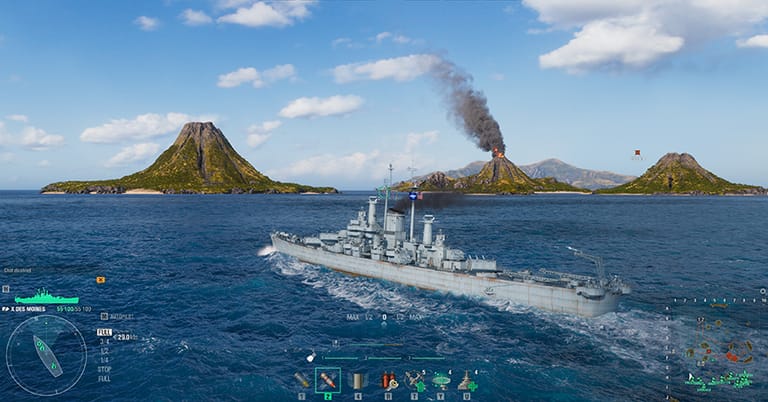
The wiki calls this class 'versatile ships which can use either their rapid fire guns to chip away at enemies or their torpedoes to cause devastating damage'. They punch above their weight through 'speed, maneuverability, stealth and astounding firepower'. Torpedoes 'do not reveal the destroyer's location', and a smoke generator hides the ship as long as it stays inside the smoke.
The cost is fragility. Destroyers 'have the smallest amounts health pools', offset only by being the one class without a citadel.
For a beginner this is the highest-variance class: exhilarating once you understand concealment, and bewildering before you do. Try one early to learn how spotting works, but do not make it your first main line.
Cruisers
The wiki calls this class the 'jack-of-all-trades, master-of-none class of warship', expected to 'outgun anything they cannot outrun, and outrun anything they cannot outgun', most commonly acting 'as destroyer and AA screens'. Its advice is that 'a good cruiser captain watches the flow of battle and adapts to the circumstances as they unfold.'
That adaptability cuts both ways for new players: cruisers do a bit of everything, so they teach the whole game, but they have the least margin for a bad angle against a battleship's guns. They are the most educational first choice, not the most forgiving.
Battleships
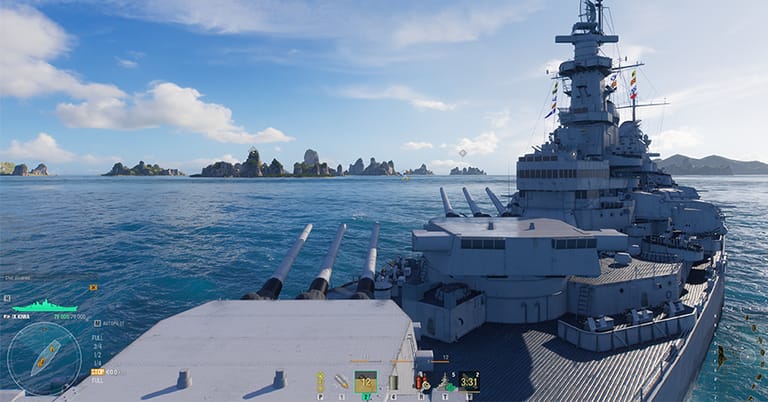
The wiki calls this class 'the heaviest, and some of the most powerful ships in the game', able to 'weather more fire than any other class'. Their weaknesses are slow rudder shift and turret traverse, which make them 'unable to respond quickly to rapid changes in the battlefield', and torpedoes. Unescorted battleships 'are nothing but sitting ducks', it warns, and captains should 'think several steps ahead before taking any action'.
Battleships are the most forgiving first line: their health lets you survive mistakes long enough to notice them. The trap is that they are also the easiest class to play badly without noticing, sitting at maximum range and feeling useful while contributing little. Start here for room to learn aiming and angling, but commit to moving with your team.
Aircraft Carriers
This class 'starts off at Tier IV' with attack aircraft, dive bombers and torpedo planes. Captains 'keep their vessel far from the main action of a battle and instead participate with individual squadrons'. The wiki describes that as an ability to 'influence the flow of battle from a safe distance like no one else can', and notes carriers are 'incredibly vulnerable' once enemies reach them, with no player-controlled guns.
Carriers are a different game inside the game: you fly squadrons rather than steer a ship, and you spot for your whole team. We would not recommend them first, because you learn little about the surface combat the rest of the game is built on.
Submarines
Submarines became a permanent class with Update 11.9, and the wiki lists them at Tiers VI, VIII and X.
Because they only appear from Tier VI, submarines are not a starting decision. Come back to them once positioning and detection make sense; both matter even more underwater.
Best Beginner Strategy
Every class shares four fundamentals, and they are the difference between a player who improves and one who plateaus at Tier V.
Wargaming's own beginner advice covers three of them: 'Stay on the move — constantly change course and speed', predict where your opponent will be rather than where they are, and use the minimap. The fourth is patience with your damage control, which puts out fires and stops flooding but cannot be used again for a while.
Movement first: a ship on a straight line at constant speed is the easiest target in the game, and a small course change while shells are in the air turns a citadel hit into a miss. Prediction second: aim where the enemy will be when your shells arrive, watching their bow and wake rather than their hull. Minimap third: it shows every detected enemy, every ally and the capture points. Damage control fourth: one fire is not an emergency, and spending your repair on it leaves you helpless against the next two.
Learn Positioning Before Chasing Damage
New players measure a good battle in damage dealt; experienced players measure it in where they were when it mattered. With no respawn, the team that keeps more ships alive into the second half has more guns, more spotting and more options, and a ship that dies early with a big damage number has usually handed the enemy that advantage.
Good positioning means three things. Have an escape: never commit to a position you cannot leave under fire, which usually means keeping an island or the map edge as a fallback. Use angles: a ship pointed at or away from the enemy presents far less to hit than one showing its full side, and battleships in particular live or die by this. Stay with support: a lone ship of any class is a target, and the wiki's warning about unescorted battleships applies to everyone.
Understand Detection and Map Awareness
Detection works on ranges. Every ship has a surface detection range, 'the range at which a ship or aircraft will be detected by an enemy ship', and an air detection range for enemy aircraft, both requiring line of sight. Firing your main guns temporarily raises your detectability to the current range of those guns, and a ship on fire outside smoke has two kilometres added to its detection ranges.
Spotting is shared: enemies detected by anyone on your team appear on everyone's minimap. Smoke blocks line of sight and can keep a ship inside it undetected, although firing from smoke still raises detectability. Destroyers have the lowest detection ranges but also 'typically have the shortest view ranges'.
This explains the classic beginner question, 'why did everyone shoot me the moment I fired?' Your ship was invisible until your guns bloomed its detection to their full range, and every enemy inside it saw you at once. Treat each salvo as a decision to be seen: fire when you have a target worth it and an escape ready, not because your guns are loaded.
Map awareness follows from the same system. Because spotting is shared, your minimap shows what the whole team can see, and a glance every few seconds tells you where the enemy is concentrating long before their shells do.
Don't Rush Through Ship Tiers
Wargaming's wiki is unusually direct about this: 'Do not feel that you must race up the tiers as quickly as possible!' Its recommendation is to play across several nations and classes up to Tier VI before specialising.
The economy reinforces the advice. Credits pay for 'servicing and resupply after each battle' as well as ships, modules, upgrades and commanders, and higher tiers cost more to run. Ship experience researches the next ship in a line; Free Experience, unlocked at Access Level 6 and earned at 10% of base experience, is a shared pool that can substitute for it.
A Tier VIII ship in the hands of someone who skipped the lessons of Tier IV is a liability to their team and a frustration to themselves: the opponents are better, the service costs higher, and cheap mistakes become expensive ones. Spend time at Tiers IV to VI, where the game teaches most of what it has to teach and a bad battle costs least.
Upgrade Your Ships Carefully
Modules and upgrades are bought with credits once researched, and commanders gain skills through battle, with up to 21 skill points available. Doubloons are the premium currency; the wiki lists a standard conversion of one doubloon to 1,500 credits.
Three rules keep a beginner's credits intact. Research the hull and the modules that improve survivability or gun handling before moving on; a stock ship is deliberately weaker than the same ship upgraded. Do not sell ships you enjoyed at a tier you might return to. Spend nothing on doubloons until you know which line you want to play; premium currency accelerates a plan and cannot substitute for one.
A premium account increases what you earn: the wiki lists a 50% bonus to credits for premium holders and describes two premium tiers, Wargaming Premium and Warships Premium, with different experience bonuses.
Whether that is worth paying for depends on how much you play: it multiplies earnings, it does not create them.
Playing World of Warships on PC
The Steam listing gives the minimum requirements as Windows 7 x64, an Intel Core i3-3210 or AMD Athlon X4 970, 6 GB of RAM, a GeForce GT 640, Intel UHD 630 or Radeon R7 240, DirectX 11 and 67.2 GB of storage. Recommended: Windows 7 x64 through Windows 11, a Core i5-10400 or Ryzen 5 3600, 8 GB of RAM and a GeForce GTX 770 or Radeon RX 570.
| Component | Minimum (Steam) | Recommended (Steam) |
|---|---|---|
| OS | Windows 7 x64 | Windows 7 x64 / 8.1 / 10 / 11 |
| CPU | Core i3-3210 / Athlon X4 970 | Core i5-10400 / Ryzen 5 3600 |
| RAM | 6 GB | 8 GB |
| GPU | GT 640 / UHD 630 / R7 240 | GTX 770 / RX 570 |
| Storage | 67.2 GB | 67.2 GB |
These are modest requirements by 2026 standards; the minimum names integrated Intel graphics, so many office laptops will run the game at reduced settings. The line to respect is storage. If you are unsure how your hardware compares, our setup guide walks through reading a spec sheet.
→ How to know if your PC can run a game: CPU, GPU, RAM and VRAM explained
The game is rated PEGI 12 on Steam, with descriptors for in-game purchases including random items and online interactivity.
Is World of Warships Worth Starting in 2026?
For the right player, yes. The game rewards thinking over reflexes, it is free to learn, and a decade of development has produced a roster and modes a new player will not exhaust for a long time. The learning curve is real but front-loaded: the fundamentals in this guide carry you through most tiers, and Co-op exists so you can learn them without pressure.
The honest caveat is the one Wikipedia records about its business model: 'significant progress can be made without purchasing anything, but access to higher levels of play and additional warships becomes progressively more difficult without financial investment.'
Read that as a description of pace, not access: the tech-tree ships are reachable for free, and money shortens the wait. If you enjoy the game at Tier V, you will know whether that wait is one you mind. For a faster, more arcade-like take on vehicle combat, War Thunder is the obvious comparison; if you are still deciding what to play, our free PC games round-up covers the field.
→ War Thunder beginner's guide 2026
→ 15 best free PC games to play in September 2026
Frequently asked questions
Is World of Warships free to play?
Yes. It is free to install and play on PC through Steam or Wargaming's launcher. It sells premium currency, premium ships and premium account time that speed progression; the tech-tree ships are reachable without paying.
Is World of Warships difficult for beginners?
It has a real learning curve, but a front-loaded one. New accounts start in Co-op battles against bots, and the fundamentals — movement, aiming ahead of the target, reading the minimap and understanding detection — carry you through most of the tiers.
What ship class is easiest to learn?
Battleships are the most forgiving because their health lets you survive mistakes long enough to learn from them. Cruisers teach the most about the whole game. Destroyers and carriers are best tried after you understand detection and positioning.
Can you play World of Warships on PC?
Yes. The PC version is the original game, released for Windows in 2015 and on Steam in 2017. The console version, Legends, and the mobile version, Blitz, are separate games.
Does progression require spending money?
No. Wikipedia's summary is that significant progress can be made without purchasing anything, while higher tiers become progressively harder to reach without spending. Money buys time, not access.
Sources
- World of Warships — Wikipedia — Wikipedia, accessed 2026-09-03
- World of Warships on Steam — store page and system requirements — Valve / Steam, accessed 2026-09-03
- World of Warships Wiki — main page (official) — Wargaming, accessed 2026-09-03
- World of Warships — official site — Wargaming, accessed 2026-09-03
- Game Basics — World of Warships Wiki (official) — Wargaming, accessed 2026-09-03
- Destroyers — World of Warships Wiki (official) — Wargaming, accessed 2026-09-03
- Cruisers — World of Warships Wiki (official) — Wargaming, accessed 2026-09-03
- Battleships — World of Warships Wiki (official) — Wargaming, accessed 2026-09-03
- Aircraft Carriers — World of Warships Wiki (official) — Wargaming, accessed 2026-09-03
- Detection — World of Warships Wiki (official) — Wargaming, accessed 2026-09-03
- Economy — World of Warships Wiki (official) — Wargaming, accessed 2026-09-03
Read next
World of Warships: Guides and Game Overview
The World of Warships hub: sourced facts about Wargaming's free-to-play naval MMO — release, platforms, ship classes, economy and PC requirements — and NextPlayWire's beginner guide.

How to Know If Your PC Can Run a Game: CPU, GPU, RAM and VRAM Explained
A practical, no-guesswork method for reading a game's system requirements against your own hardware — where to find your specs, what each line means and which shortcuts to distrust.